Skip to content
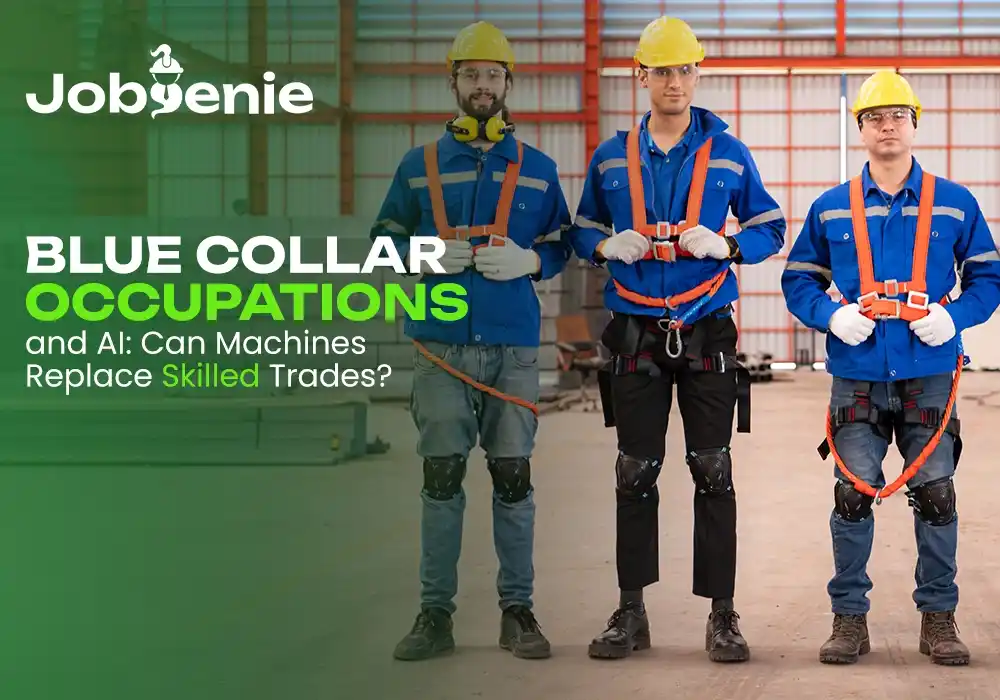
Over the decades, the world has been dependent on blue-collar jobs. The construction of cities and the upholding of infrastructure to sustain basic services are some of the functions that constitute daily life. In contemporary times, when machines are taking over industries through artificial intelligence and automation, a major concern is the following: Can machines substitute skilled trades? The answer is no. This gives the reason why the future of skilled trade work will remain dominated by human capability, opinion, flexibility, and experience, particularly in the blue-collar occupations.
The Modern Economy And Blue Collar Occupations
Blue-collar jobs are usually practical tasks that are physical and demand hands-on work, technical education, and real world solution. These are employment opportunities in the construction, manufacturing, logistics, maintenance, utilities, and service industries.
The list of blue-collar occupations that are practical is:
- Electricians and plumbers
- HVAC technicians
- Welders and machinists
- Construction laborers
- Warehouse associates
- Mechanics and technicians
- Repair and maintenance engineers.
These jobs are not monotonous assembly jobs. They require situational awareness, decision-making, and flexibility, particularly when conditions change unpredictably.
These are unique human needs, even amid rapid technological advancement.
AI and Blue-Collar Jobs: Evolution, Not Elimination
The discussion has been based more on fear of the potential disappearance of the blue-collar worker, the ability of machines to take over the workplace, and the loss of opportunities through automation. As a matter of fact, the role of AI is much more helpful than harmful.
AI excels at:
- Data analysis.
- Scheduling and forecasting.
- Anticipatory maintenance warnings.
- Safety monitoring.
- Workflow optimization.
The challenge that AI will not be able to perform is to recreate human intuition, dexterity, and accountability in the workplace in the real world.
To illustrate, a machine can indicate a possible problem with the equipment; still, it requires a talented tradesman to identify the problem, the appropriate repair procedure, and safety measures.
Why Skilled Trades Workers Cannot Be Replaced
The work environment of skilled trades workers is erratic in nature. There are no two job sites that are the same. The weather changes, materials differ, and there is always an unforeseen difficulty.
The following are the reasons why machines are inadequate:
1. Human Judgment
AI relies on patterns. Experienced employees are dependent on experience. Human beings adjust immediately when things are not working out as per the data.
2. Physical Dexterity
Hand-eye coordination and balance, as well as fine motor skills, are very hard to automate, particularly in tight corners or dangerous areas.
3. Accountability and Trust
People have to make safety-critical decisions, not machines, and businesses and clients trust them.
4. On-the-Spot Problem Solving
AI follows instructions. The problems that are solved by human beings have never existed before.
All these aspects render competent trades workers incomparable, even in the case of highly developed automation.
The Growing Importance of Repair and Maintenance Jobs
Another forgotten fact regarding automation is the fact that machines, too, need maintenance. With the growth in technology, there will be an increased demand for professionals who can install, repair, and maintain it.
The number of repair and maintenance work is increasing at a faster rate than most white-collar positions due to:
- There is a higher level of complexity in the equipment.
- The cost of downtime increases.
- It is essential for preventive maintenance.
Artificial intelligence can anticipate breakdowns, though it is not able to climb a ladder, enter a tight area, or fix industrial machinery safely. Professionals are engaged to do that job. This fact guarantees blue-collar skills in the long-term.
Flexibility In The Workforce And The Casual Labour Jobs
The other domain that blue-collar occupations excel in is the flexibility of the workforce.
Most employees nowadays desire casual employment with the following advantages:
- Flexible schedules.
- Short-term commitment.
- Multiple income streams.
- Skill diversification.
This change is not displacing workers because technology helps in the change. Smart automation systems such as JobGenie pair workers with opportunities more quickly, but with humans at the core of the hiring process.
For businesses, this means reliable staffing. To employees, it is freedom and power.
Talent Recruitment In The Age Of AI: Blue Collar Jobs
The recruitment of blue-collar workers has undergone a change due to AI, but not at the expense of the process. Rather, it eliminates inefficiencies that previously made the hiring process slow and unpredictable.
The contemporary recruiting tools are currently:
- Reduce paperwork
- Improve job matching
- Speed up shift fulfillment
- Make sure about open payments.
Technology can be used to the advantage of the workers at JobGenie rather than to their disadvantage. Logistics are managed by smart systems, and fairness, clarity, and trust are guaranteed by real human support on both ends. It leads to the creation of a hiring process that appreciates the worth of blue-collar labour.
Why Blue Collar Occupations Deserve More Priority
Digital careers are glorified by society, while other jobs that help cities operate. This is an imbalance that is to be corrected.
The blue-collar occupations should be given more priority since they:
- Fund the basic infrastructure.
- Cannot be outsourced or fully automated.
- Provide stable and skill-based professions.
- Offer actual material stamina.
When global disruptions occur, blue-collar workers continue to deliver supply chains, maintain facilities, and keep communities secure.
AI did not replace them at that time- and it will not replace them in the days to come.
Human Advantage In An Automated World
The more automation is introduced, the more human skills it makes valuable. Machines are unable to imitate the qualities of communication, adaptability, craftsmanship, and responsibility.
The future of work is not humans versus machines.
It is humans working smarter with machines.
The future will be dominated by blue-collar workers who will accept technology as an asset and not a menace.
Concluding Remarks: Blue Collar Occupations Here To Stay
And therefore, is it possible to substitute skilled trades with machines?
The evidence says no.
Blue-collar occupations are changing, getting stronger, and becoming more vital in a technological world. Artificial intelligence is going to transform organizational work, although it will never substitute the human hands, brains, and experience of a skilled trade.
At JobGenie, we are happy to serve those people who create, repair, transport, and maintain the surrounding world because no algorithm can replace human skill.
The future of work is human. And blue-collar laborers will still be in command.